
Written by Upgrade Home Services, licensed HVAC contractor since 2002 · November 16, 2026
Do heat pumps keep Bay Area homes warm in a cold snap?
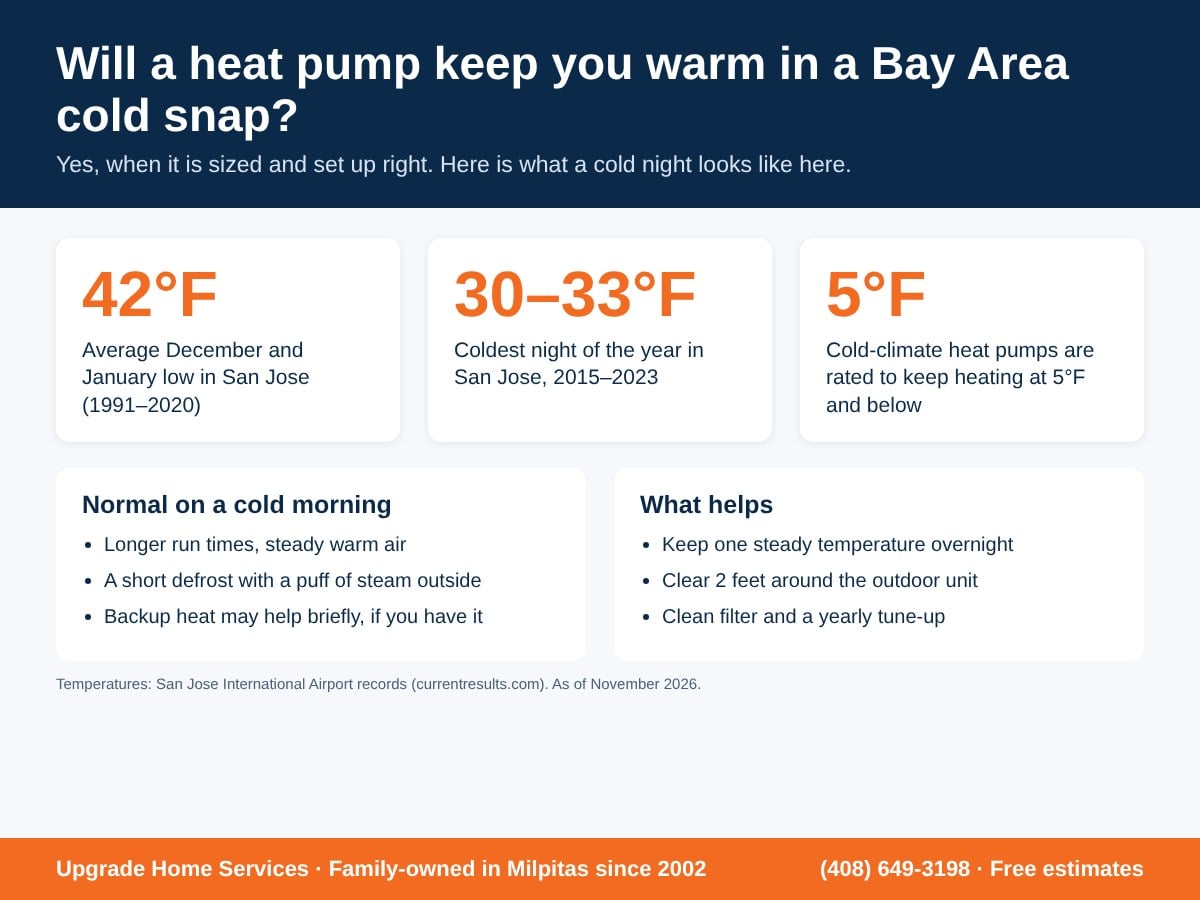
Yes. A heat pump that is sized and installed correctly keeps a Bay Area home warm on our coldest nights, because our cold snaps rarely drop much below freezing. In San Jose, the coldest night of the year has landed between 30°F and 33°F every year from 2015 to 2023, well within what today’s heat pumps are built to handle.
A heat pump heats your home by moving heat from the outdoor air to the inside, even when that air feels cold to you. If you live in Milpitas, San Jose, Santa Clara, Palo Alto, San Mateo or Burlingame, here is what to expect when a cold front rolls in, and what helps.
How cold does it get in the Bay Area, and how cold can a heat pump go?
San Jose’s average low in December and January is about 42°F, based on 1991–2020 records from San Jose International Airport (yearly lows, monthly averages). Inland valleys and hillsides can run a few degrees colder.
Heat pumps lose some heating power as the outdoor temperature falls, so the question is whether yours still has enough at your coldest hour. Many current inverter heat pumps are designed to keep heating well below freezing, and cold-climate models are tested to keep heating at 5°F. Here is what that looks like in practice.
| Outdoor temperature | How often in the Bay Area | What a well-sized heat pump does |
|---|---|---|
| 45–60°F | Most winter days and nights | Runs in short, quiet cycles and heats efficiently |
| 35–45°F | Typical cold nights | Runs longer and more steadily, still heats on its own |
| 28–35°F | A few nights in a cold snap | Runs most of the time, defrosts now and then; backup heat may help briefly |
| Below 28°F | Rare in most of our service area | A cold-climate model keeps heating; an older or undersized unit may need backup heat |
Why does the air from my heat pump feel cooler than my old furnace?
That is normal. A gas furnace sends short blasts of very hot air, then shuts off. A heat pump sends a longer, steady stream of warm air, often in the 90s°F at the vent, which can feel cool on your hand even while the room temperature holds steady. Judge it by the thermostat reading and how the room feels after an hour, not by the vent.
If rooms at the end of long duct runs stay cold, the cause is often the ductwork, not the heat pump. Leaky or undersized ducts lose heat before it reaches you. We check this during every heat pump estimate.
Why is my heat pump steaming or making a whoosh sound on a cold morning?
It is most likely a defrost cycle. When the outdoor coil gets a thin layer of frost, the heat pump briefly reverses to melt it. You may see a cloud of steam rise from the outdoor unit and hear a whoosh as it switches back. A defrost usually lasts a few minutes and can happen several times on a frosty morning.
A light coat of frost that clears on its own is fine. Thick ice that stays on the unit for hours is not, and it is worth a service call.
Do I need backup heat with a heat pump in the Bay Area?
Usually not much. Many ducted heat pumps include electric heat strips in the indoor unit that switch on when the heat pump needs help, such as during defrost or a recovery from a big setback. In our climate they should run only briefly. Some homes keep a gas furnace as backup in a dual-fuel setup instead.
The bigger factor is sizing. A heat pump sized from a load calculation for your home, not just matched to the old unit, handles our cold nights with little or no backup. See how we approach it on our heat pump installation page for San Jose.
How should I set my thermostat during a cold snap?
Keep it simple and steady. Use this checklist when a cold front is on the way.
- Pick one comfortable temperature and leave it there overnight. Big setbacks make the heat pump work hard in the morning and can bring on backup heat.
- Use Heat mode, not Emergency Heat. Emergency Heat turns off the heat pump and runs only backup heat.
- Keep about 2 feet clear around the outdoor unit. Move leaves, covers and stored items away.
- Check the air filter. A clogged filter cuts airflow when you need it most.
When should I call a pro about my heat pump?
Call us if any of these happen during a cold snap:
- Thick ice stays on the outdoor unit for hours.
- The house will not reach the thermostat setting when it is above freezing outside.
- The thermostat shows Emergency Heat or Aux Heat running almost all the time.
- You hear grinding, rattling or loud banging from either unit.
- The thermostat or outdoor unit shows an error code.
A yearly heat pump tune-up before winter catches most of these early. We are open Monday to Saturday, 8 AM to 5 PM, and serve Santa Clara and San Mateo counties, including Milpitas.
Are there rebates for switching to a heat pump in Santa Clara and San Mateo counties?
You may qualify, depending on your power provider, your city and the equipment you replace. As of November 2026, these programs list heat pump heating and cooling rebates for homeowners in our area. Rules and funding change often, and some programs require approval before the install, so check the official page first:
- Silicon Valley Clean Energy home rebates (most Santa Clara County cities)
- San José Clean Energy EcoHome Rebate (San Jose)
- Peninsula Clean Energy heating and cooling (San Mateo County)
Federal heat pump tax credits ended in 2025, so do not count on one for a new install. We never promise a dollar amount. Call us and we will check what applies to your home.
What does a heat pump look like in a real Peninsula home?
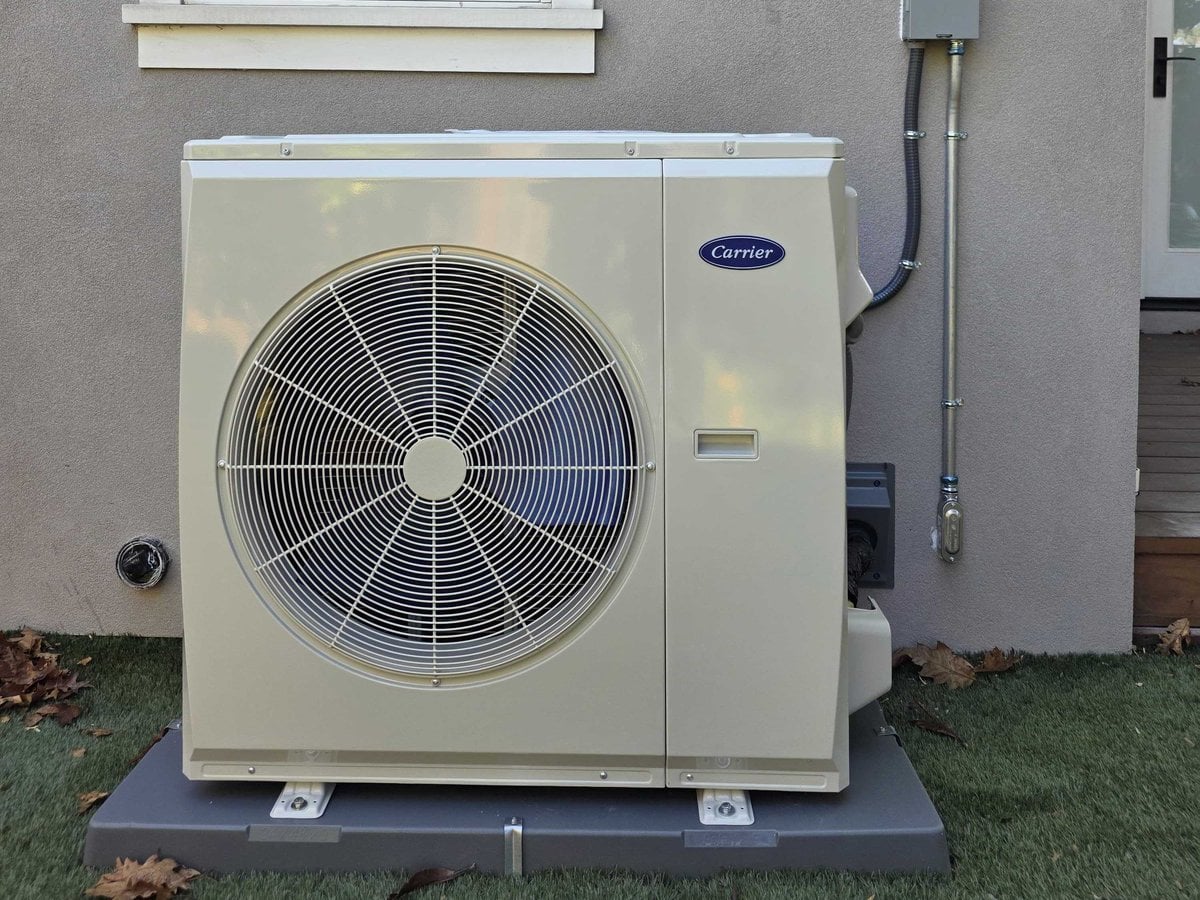
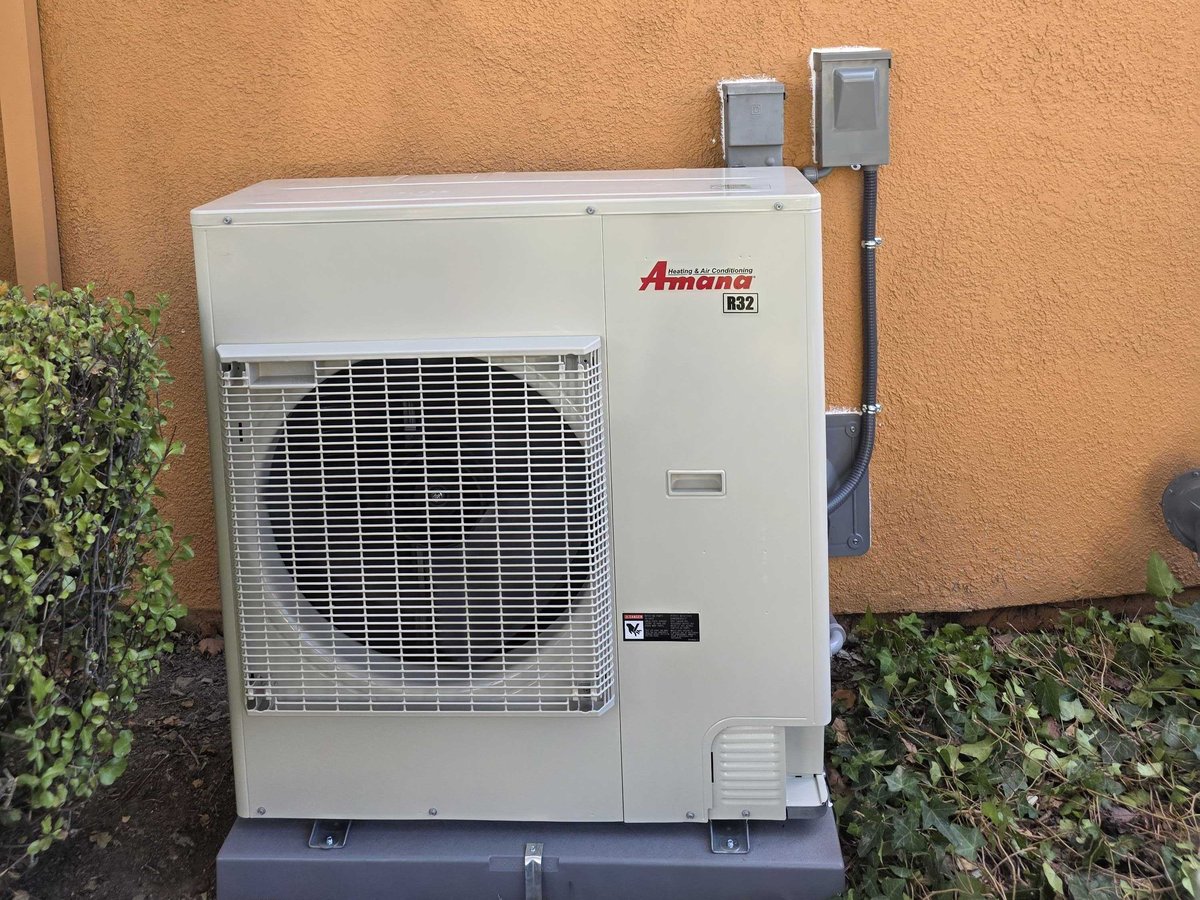
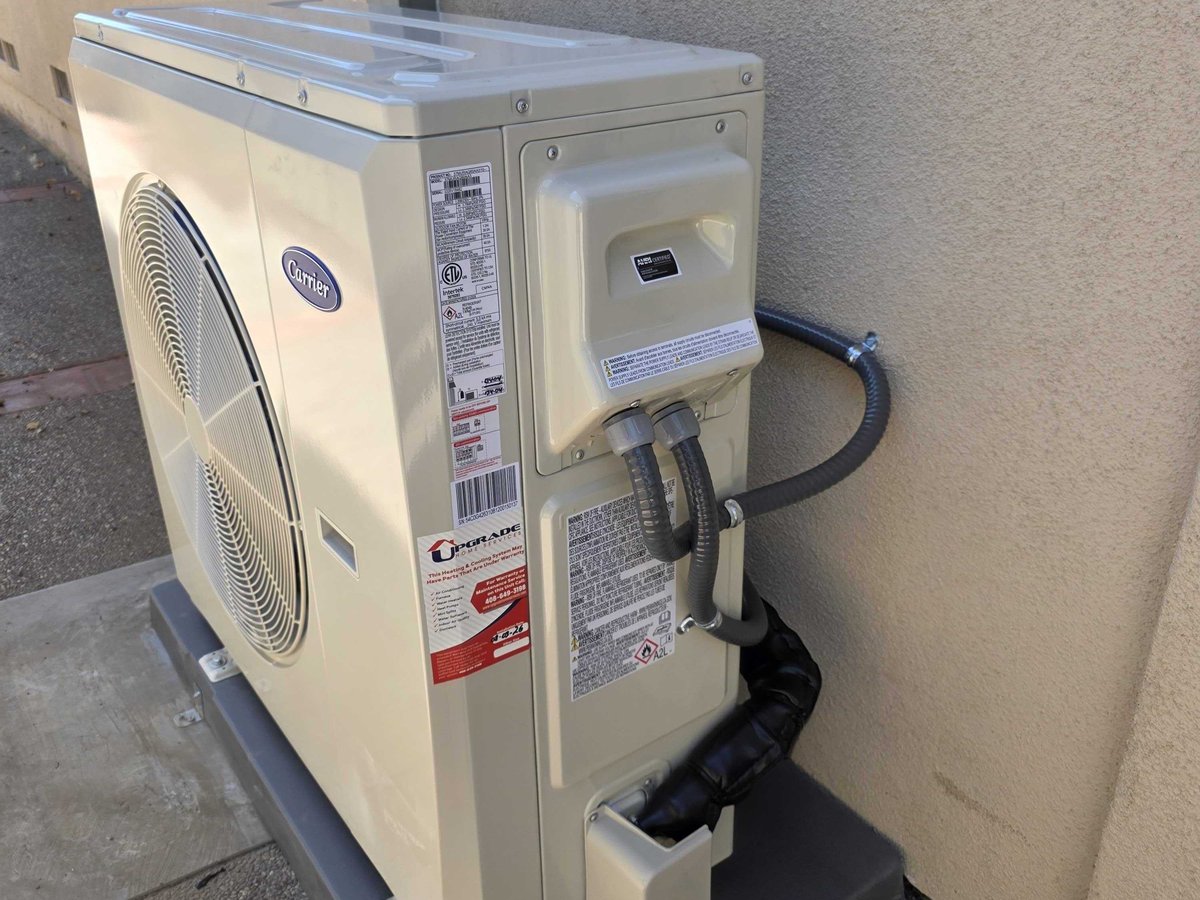
See two recent installs: a Carrier heat pump that replaced a gas furnace in Burlingame and an Amana heat pump in San Mateo.
Frequently asked questions
Will my heat pump stop working if it freezes outside?
No. A heat pump keeps heating below freezing. It may run longer and defrost now and then, which is normal. Bay Area cold snaps usually bottom out around 30°F, which most modern heat pumps handle well.
Should I turn my heat pump off at night to save money?
Usually not. Keeping one steady temperature, or a small setback of a couple of degrees, often uses less energy than a big setback, because a cold-morning recovery can bring on backup heat.
Should I cover my heat pump in winter?
No. The outdoor unit needs airflow to heat your home and to drain defrost water. Keep about 2 feet clear on every side.
Thinking about a heat pump, or want yours checked before the cold?
Family-owned in Milpitas since 2002, serving Santa Clara and San Mateo counties. Licensed, CSLB #1066776. Open Monday to Saturday, 8 AM to 5 PM.
Call (408) 649-3198 · Free estimates.
Questions about your system?
Upgrade Home Services is family-owned in Milpitas since 2002. Licensed, CSLB #1066776 · B, C-20. Free estimates on new and replacement systems.